
Interview with Carmen Burridge
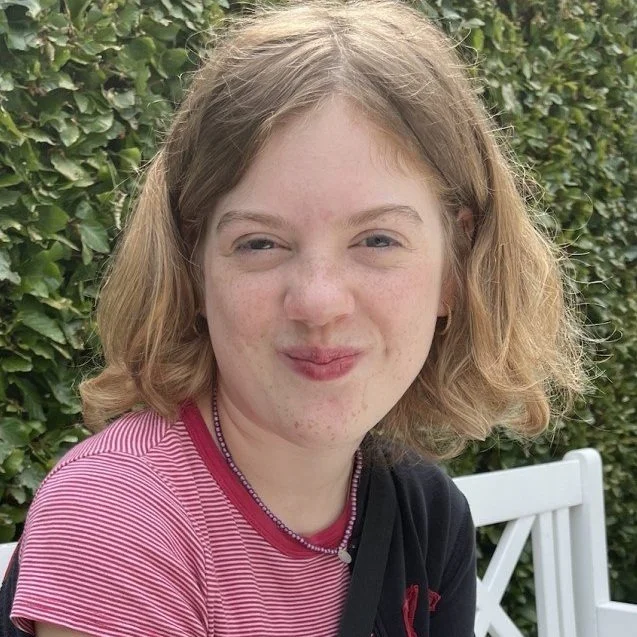
Carmen Violet Burridge is a Liberal Arts student who studies modules in History, English Literature, Spanish and Screenwriting. She loves being able to explore multiple subjects that she’s passionate about, as well as receiving a holistic educational experience within her degree. Carmen particularly values her classes in screenwriting and the creativity it encourages, as it will aid her in her journey to a career in writing for the screen.
Carmen’s top tips:
Let your ideas run and take note of everything… You can edit afterwards!
When writing a dialogue, have someone else read it aloud to see if it makes sense.
Make sure that every word means something in your writing.
ISOBEL: For this interview, I'm joined by Carmen. We'll be discussing her work on script writing. So, if you just want to start by talking about what the writing is about, and what interested you in the topic?
CARMEN: Yeah, sure. So, it's a radio play that kind of focuses on murder as a theme, but also the power of music in general. And like, yeah, I just tried to merge those two together in a very short space.
ISOBEL: When you were, kind of planning and researching, how did you go about that?
CARMEN: Because it's particularly creative… You know, script writing. I just wrote a bunch of ideas down for this one, like five or six, just let my imagination kind of run. And then you look into like, what's most plausible, what is doable in the amount of space you have, and everything. And then for this one in particular, I obviously had to just basically listen to some Chopin, while I was writing it, which kind of helped me just get in the vibe a bit.
ISOBEL: I mean, it's quite an interesting script, I think. The suspense really builds on it. And as I was reading, I was more and more interested! Were there any books or articles, or like a show that you kind of took inspiration from? And how did you figure out how to use notes from the piano and put that into the script?
CARMEN: Yeah, so I do a screenwriting module at uni. So, the whole time they were teaching us how to write for the screen, it’s all about writing visually (and) using action to say things. And then they go, “right, we need you to write a radio play.” So, scrap that, you now have to write about thinking about what you can hear. So, I found that difficult, because I write scripts in my own time, so I'm really used to writing (that way). So, I kind of chose the piano… I looked at other radio plays and saw how they use other themes that mean, you hear interesting sound. And I thought, how can I make the plot have what you hear as such a big part of it. So, that is how I ended up with the notes helping him realise that Ada is the killer. As a listener, that would be the most interesting thing, if what you hear, kind of convicts this person. So yeah!
ISOBEL: Definitely. Was there anything that you felt when you were writing it that you really struggled with? And felt was a major challenge? If you did, how did you overcome that? And how did you figure out how to navigate around it?
CARMEN: Yeah, so initially, I found it really a real struggle to keep it so concise. We had three characters and three scenes in just five pages. And obviously, especially with the layout of a script, that really isn't a lot of space. So, I found that really difficult. But in the end, it was actually a really good exercise, because it meant that each line had to mean something. Which is how you should write anyway! But it helps you (kind of) really cut out anything you didn't need, and really make it a kind of sharp, snappy piece.
ISOBEL: Character development is so important, so doing it within a small amount of script and a small amount of time to develop them… It’s important to make every line mean something. What do you think that you have gained from writing this piece?
CARMEN: As I said, like it just it really trained me to cut out all that stuff you don't need in a script, which just becomes a bit of dead space. So, it was kind of useful to train me to do that. But also, I had to come up with this idea fairly quickly because of the timescale of the assignment, which I was initially really stressed about, but it taught me to kind of just let go and then ideas just come to you. It also taught me (because my first draft of this was a lot worse than this is) the value of rewrites and basically how valuable they are because it takes multiple goes to develop a proper, good script.
ISOBEL: (slightly cut off) It sounds like a conversation, not like essay writing. So, was there a anything that you think was helpful when learning how to do that? Like, did you have any skills that you gained from learning how to make it speech-like?
CARMEN: Yeah, (definitely) lectures helped because they showed us a lot. Just watching a lot of stuff helps, because yeah, that's one way to learn. A really good way… But, also reading it out loud is really, really good too because, in your head sometimes things, you think, “Yeah, that works.” But when you read it out loud, it's quite clunky as dialogue. So yeah, reading it out loud… And having another person read it out loud is even better, because they haven't seen it. And if that flows easily, then it means it's working!
ISOBEL: Amazing. So, a little bit more broad now. Looking back at your second year, what would be your main advice for second year students in the creative writing field?
CARMEN: Probably… I'd say let your ideas run, even if it you know it seems really unlikely or unrealistic. Just let your mind run with them. Just write down everything that comes into your head regarding an idea and then you can always, you know, edit after. So, I'd say that, yeah, that initial imagination is key.
ISOBEL: Amazing. Thank you so much.