
Interview with Laura Kee
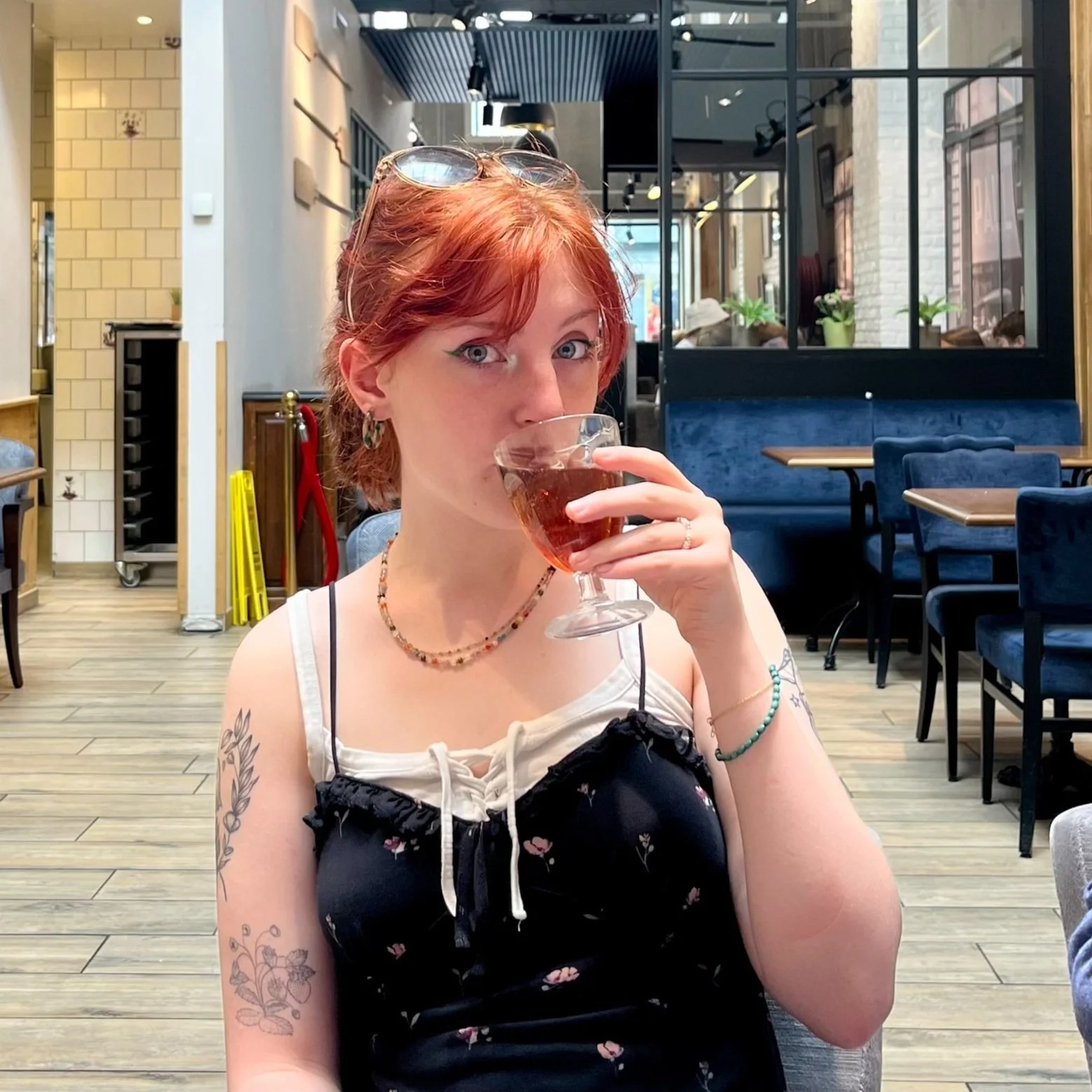
Laura is a Music and English student from southwest London. As a trumpet player, she has partaken in local ensembles consistently from a young age - but academically prefers essays and analysis to performing.
Laura’s top tips:
Choose a topic you’re passionate about and choose module options that interest you.
Mieke: Today I'm joined by Laura, who is a Music and English undergraduate, and she'll be discussing her essay on the use of pre-existing songs in film soundtracks. Laura, can you start by telling me what your piece of writing is about and what interested you in the topic?
Laura: My essay focuses on the song ‘Take Me Home Country Roads’ by John Denver and how that is used in the Studio Ghibli film Whisper of the Heart. It interested me because I spent ages trying to think of a film that I wanted to study for this because I'm not too into films. It took me a while, but I do love Studio Ghibli films, and this was one of the rare cases in a Ghibli film of a pre-existing song being used in the soundtrack. The film’s written by one of my favorite writers at the studio, Hayao Miyazaki, I just thought that would be very interesting.
Mieke: How did you go about planning, researching, and drafting this essay?
Laura: It was very different because obviously the films are very important part of film music. I spent a lot of time watching the film, which was fun, but also it was a lot of stopping and starting and thinking ‘is that a significant moment to talk about or not?’ Then it was listening to the soundtrack and searching for broader sources because it's a very specific focus I chose for this essay with the one film, the one song, so obviously not many people have written about that specifically. So, I was looking for some broader sources on intertextuality and pre-existing songs and in film music.
Mieke: Was it difficult to plan this type of essay?
Laura: Yes, because it’s very niche. There were hardly any sources available if I wanted to be specific. So, I was tailoring the broader sources, taking very specific quotes to try and make them fit what I needed. One of those sources was Claudia Gorbman, who is very significant in analysis of film music. We looked at her a lot in our lectures, her quotes were everywhere. I took a lot from her book Unheard Melodies and tried to make it fit what I was doing.
Mieke: As well as Claudia Gorbman's book, were there any other books or articles that you found useful when writing this piece?
Laura: There was, Jennifer Lauren Psujek, her PhD dissertation was on the composite score. And there was one specific example she used that was quite helpful for a point of comparison for my analysis, because it was also a specific song and a specific film used narratively, which was looking at Baz Luhrmann’s Moulin Rouge, where they used Elton John's ‘Your Song’ as the motif or theme as both diegetic and extradiegetic, which just relates to what I was talking about in the same setting which was helpful.
Mieke: What challenges did you face while writing the essay, and how did you overcome them?
Laura: As I’ve said, there were limited secondary resources. But aside from readings and getting quotes for the essay, this made it difficult because I had to spend a lot of time with the films, stopping and starting it because there wasn't anywhere online to tell me a time stamp for when a song and motif is used. I did just spend a lot of time with the film and the soundtrack; stopping, getting the time stamp for my essay, listening to it repeatedly, trying to find new things. Or: ‘here's something I hadn't heard before’, which did pay off because I found some interesting connections and the motif of the film is very fun. I will never forget it now I've heard it's so many times. But I just had to do all of that myself instead of finding it online.
Mieke: What have you gained from writing the essay?
Laura: I think the essay helped me in a way where I found my own with the argument, because there was so little on it before. There was a lot of my own thoughts, my own thinking. So, because the question was very broad, but my focus was quite niche, all the ideas had to come straight from me. Usually, with my essays it's very easy to take inspiration from another critic you've found, or if you really agree with them. But there was no one here for me to agree on the point with because the point was just my own. Which was fun actually, I felt it gave me a lot of direction with how I write and something I've been able to take to other essays where there's more of what I think in the essay rather than what I've heard elsewhere and I'm just bringing into the essay.
Mieke: Do you feel then with this essay that it was quite refreshing and writing just about your own opinion? And did you find that it helped you develop your sense of opinion and argument for other essays?
Laura: Yeah, it was a while ago now that I wrote this essay, and it still stands out to me as one of my favorite essays I've written. It’s a turning point essay with the amount of planning I did as well. Obviously, I plan all my essays, but this was the clearest plan I've ever done, the longest, most detailed one, just because I was interested in what I was doing. And I found out I had a lot more to say about it than maybe a year ago I would have thought I would be able to think about something.
Mieke: Would you say that this essay took more planning than your other essays just because of all the listening to music?
Laura: Yes. A lot of unconventional planning in terms of I don't sit and watch films for my other essays usually.
Mieke: Do you feel that you now see this film differently, do you love it more now that you've written this essay?
Laura: I haven't watched the film since. But I do appreciate the film a lot more and although I've not watched the film since, I do listen to soundtrack quite a lot still, just because I know the motifs now. So, it's just something I know and something I like to listen to. And I definitely appreciate it a lot more for what it is.
Mieke: Looking back at your second year, what would be your key advice for students in the Music department?
Laura: Definitely choose the topic with your writing that you're actually interested in. I think for first year because we all have limited choices, it's a lot harder to write about stuff that you're not actually passionate about. But for second year, take advantage of the fact that you have more options, because if you like what you're writing about, everything will just be so much more enjoyable, and you will write a lot better for it.
Mieke: Perfect. Thank you. Thank you for joining me, Laura.
Laura: Thanks for having me.