
Interview with Maria Estrada-Fuentes, Department of Drama, Theatre and Dance
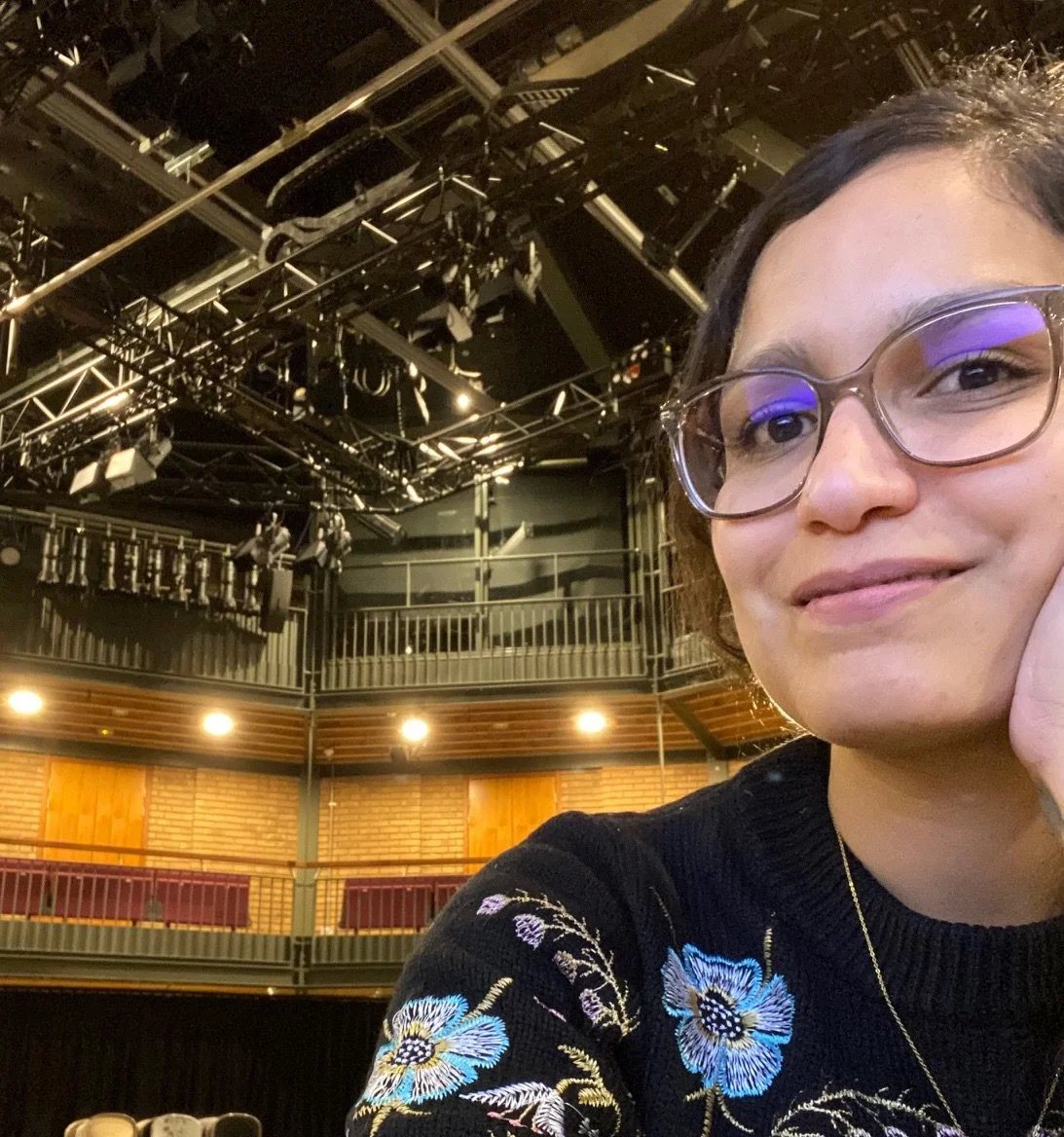
María Estrada-Fuentes is Lecturer in Latin American Performance Cultures at Royal Holloway, University of London. Before coming to Royal Holloway she was Guest Lecturer at the University of Amsterdam (2018), and Postdoctoral and Teaching Fellow at the University of Warwick (2016-18). Her research interests include arts-based conflict transformation, gender and complex victimhood, gendered and domestic violence in transitional contexts, politics and performance. Between 2018-2021 she was co-investigator in the international research project Towards a Moral Grammar of Transitional Justice: Secondary Care Practices to Support Conflict Transformation in Colombia.
In our interview, Maria discusses her article Affective Labors: Love, Care, Solidarity in the Social Reintegration of Female Ex-Combatants in Colombia. You can read it here.
GERARD: Today, we're joined by Maria Estrada-Fuentes, from the Department of Drama, Theatre and Dance. Perhaps we could start by asking you to introduce yourself and telling us a little bit about your journey into academia and also what current areas of research interest you.
MARIA: Thank you for having me here today. My name is Maria Estrada-Fuentes, I'm from Colombia. Since I was a teenager, I wanted to be a university teacher or lecturer. I didn't really know how to get there but I knew that that's where I wanted to be. This is partly because I have seen in my family - and have experienced it myself - that education really transforms lives, and gives you lots of opportunities to learn about the world, but also to engage with the world. So I wanted to be part of that.
I have a dance background and was a ballerina for ten years. I continued practising different art forms from that. I went to uni, and started psychology - and in Colombia, the degrees are five years long - so I did a year and a half of psychology and I didn't like it. I hated it from the very beginning! Then I had the opportunity, thanks to the support of my parents, to take a risk and study arts. So I did Art History and Theory. At some point, in my degree, I was able to combine my dance background with my study of arts and started working as a performance artist at the university, but also elsewhere. When I was working as a performance artist, I did a lot of solo and collaborative work, and in my collaborations, I was working mostly on the ethics of representation of political violence - and that was really interconnected with the environment that I grew up with: Columbia and its history of violence.
But at some point, it didn't feel that doing art, or working as an artist on those issues was enough. Not for me. So I wanted to be able to work with communities, and engage with members of civil society who had been suffering from some form of violence, and just see how the arts could contribute. That's how my journey started into thinking about how the arts could contribute to conflict transformation and post-war reconstruction, which is something that I still do today. It is my obsession. That shift happened before I came to the UK to do an MA.
I did an MA in international performance research at the University of Warwick with the University of Tampa, in Helsinki, Finland. I learned a lot about how the arts had been used in different post-conflict societies to contribute to change. And I went back to Colombia after that, wanting to work on it. I did encounter an opportunity and worked with former child soldiers in the reintegration process, or what we call a rehabilitation process. What this means is minors - people under the age of 18 - who have been involved in any illegal military organisation - supporting them so that they can make a transition to civilian life. We were contributing to that transition through the arts. And that experience was really a tipping point, or a turning point for me in terms of my research, and the work that I went on to do for my PhD. So yeah, that's kind of a starter.
GERARD: Thank you. That's really interesting. Picking up on that concern and 'obsession', as you call it, about the situation in Colombia, perhaps we can go on to your article now, which is called Affective Labors: Love, Care, Solidarity in the Social Reintegration of Female Ex-Combatants in Colombia. Could you tell us a little bit about that article and how it came into being?
MARIA: Well, coming from that experience of working with minors, I went on to do my PhD. I wanted to have the time and the resources to be able to better understand what moving on from war to peace entails, in terms of those who have to engage in the process and those who are the members of civilian society. And I also wanted to be able to further explore some of the ideas or some of the experiences that I had identified when working with this group of minors. When I started working in this group - in this NGO [Non-Government Organisation] - we were working with female ex-combatants. I was part of the team that was in charge of planning and delivering workshops for them. And our focus was on working on issues of sexual violence that had been experienced during their participation in warfare, and on how that affected their integration process. It was, you know, a challenging experience in so many different ways. First, learning about the experiences and trying to understand them. Also, working as a primary care provider for ex-combatants, was a very draining experience. Anyone who has any kind of experience working in the care sector might be aware of that. I think that COVID over the last few years has really taught us that care can be very demanding and a very fraught experience.
GERARD: What kind of primary care did you deliver?
MARIA: We were part of a team of psychologists, social workers, and artists and philosophers that were collaborating with the government on facilitating weekly meetings with these minors, so that we could support any kind of need or issue that was experienced in the reintegration process through creative methods. So we had to translate a problem into a creative practice that could address the problem, but also help these minors to develop socialisation skills. And it might sound corny, but it's very important to forget a little bit about what was going on in their lives - for a few minutes - when they were with us. So yeah, it was part of a bigger structure of care.
It was assumed that they [the under 18 minors] had all experienced some form of sexual violence or abuse. We didn't have any detailed information of what had happened. We were working from that blanket assumption. But my experience working with them taught me that that wasn't necessarily the case. At that time, over 80% of the minors in Colombia who joined armed organisations do so voluntarily. Now, the notion of voluntary recruitment can be quite problematic because minors are experiencing different types of poverty or violence in their homes and in their communities, which I explore in the text. And so that is quite limiting and limited. There was something about the resilience and agency that characterises many people who decided to go to war, who survived war, and then who are in a reintegration processes that I was very interested in. And I was also very interested in how people survived, and how people became different things depending on which moment in their lives they were in. So in my text, I wanted to be able to understand how emotional attachments were a driver for these different stages from saying you wanted to escape a violent household, and then deciding to join a military organisation. Or, for example, if you were violently recruited, what were the affective or emotional relationships that allowed you to stay in that organisation? And why those primary care relationships at that time made it so difficult to leave the organisation? Or were also a reason to leave the organisation? And for the purpose of reintegration, [needing to] really understand that continuum of violence, but also the continuum of care to help improve the care provided by the government or NGOs to support this process.
GERARD: I just want to have a look at that article from a slightly different angle now - to talk about how you approach the research and the writing of it?
MARIA: Well, I decided to choose this article for this conversation, because this was the first article I published from my PhD. I had published before but, for me, this one was very close to my heart. Because I think I tried to address many myths about war, two of which are that former combatants - the children who go to war - are a 'lost generation'. That's really dehumanising. And it doesn't really do justice to their experiences. So I wanted to address that and humanise the experience and draw attention to all the suffering and violence but also to all the love and resilience and care that is experienced in really fraught ways, but it is there. And the need for survival that drives many decisions in this moment. And I wanted to facilitate a space in writing where other voices could be placed, and heard. So I'm not claiming here to be giving voice to anything or anyone - because that is very patronising - but I was trying to create a space and an excuse for those voices to be in dialogue with each other in different ways. And in doing so, I wanted to tackle the myth of equality in guerrilla organisations. There is this myth that women are empowered, and that they experience really good, empowering things when they go to guerilla organisations. I wanted to draw attention to how gender expectations and gendered relationships that characterise civilian life are exacerbated during warfare, and that gender roles are so prevalent during warfare. The violence is experienced differentially during warfare and the female bodies are affected in very specific ways. So I focused on that in this article, to attack the guerrilla organisations and try to demonstrate that they don't actually do what they preach - which was quite challenging.
Now, the process of writing. That was tricky because in this particular case, I conducted so many interviews - I did a lot of archival work, looking at testimonies and films to be able to write this piece. I was trying to observe and suspend judgement on whatever it is that I was noticing, experiencing or witnessing during my research. And I also conducted ethnographic work. I met many former combatants, both male and female, that informed the approach that I was taking and I tried to be very careful in how I was choosing my theory so as not to silence the voices or to overburden the voices or justify their presence with too much theory. I was very careful in how I chose my theoretical sources so that the experiences that I was trying to present in this case were clearly articulated with discussions around subjectivity and primary care from a social care perspective. And I took lots of breaks when I was writing this because writing about violence and injustice can be quite draining as well. So there is some care that one needs to engage with, in the process of working. I took my time and I tried to be careful with myself as I was doing it.
GERARD: Could you look back now at your early years as a student at university and pass on any advice that you might have to our undergraduates about how to build confidence in the world of academic writing? And perhaps you would like to look at it in a particular way as a multilingual person?
MARIA: There are two aspects here. I think one is the language and the other one is the academic culture. I did my undergraduate studies in Colombia. And the type of writing or what was expected from me in that context was very different from what I experienced here [in the UK]. When I came here to do my MA , there was this thing of encountering a completely different system - and a completely different type of writing that was expected from me. But also realising that Spanish wasn't only about Spanish as my first language, not only just about grammar, or structure or stuff like that, or where you put the commas etc. It was also a way of seeing the world in a very different way. So, at first, English, can seem very dry and mechanical and I really struggled with writing sentences that were just too long or didn't make sense in English, but in Spanish, were perfect. So it was a transition that took me many, many years - maybe three to five years - to feel confident writing in a language that wasn't my own. So it was that twofold thing.
How did I address that? I read the feedback that I was given. I requested meetings or more feedback if I couldn't understand something properly, and my lecturers and my supervisors were so generous all the time. I really took advantage of that because I really wanted to improve. I wanted to know how to do things right and to get good grades because my first grades were not good. I ended up getting a distinction in my MA dissertation. So I really worked hard on that side. I also took notes on how other authors write in English, how they phrased something. My intention was not to copy styles, but to learn about how ideas were structured and presented in a language that wasn't my own. So I had this notebook with all the sentences that I felt 'Oh, this is a really cool way of saying something, and I might use it at some point'. And I was patient with myself and gave myself time. Coming from my arts background, it's a bit like painting: you put on one layer of paint, and then you have to wait for it to dry, and then you revisit it, and make changes. You go and do that over and over again, until it's ready. Writing is the same thing. It's always a work in progress - at some point, you present something, but you will continue to write other things. So I would encourage students to think about [writing] as a work in progress that you always improve - and you can always continue to be better at the work you do. Don't give up (chuckle)!
GERARD: Can I just return to the fact that you are from Colombia, and that your first language is Spanish and just explore that a little bit - because it can be quite a complex thing, your relationship with the English language.
MARIA: So which part which shall I start with? For me, I didn't study in English before coming here. My primary and secondary education was only in Spanish. I had the occasional English classes, but there was a limitation there. On the other hand, when I was very little, from five years old until I was about seven, I went to an school where I was taught in English. I think that was very important for me. I'm not an expert in this, but I'm sure it did something to me. It was kind of easier for me to be able to learn and to practice the language. And I also went for about two or three years to this English Language Institute, just to study English. And then I got bored, and I quit, and my parents were annoyed, but that's another story. I was about 13 years old when I quit. Then I went to university, and I didn't take any English classes at all. So from 13 years old until I came here [the UK] the first time when I was 26 - I didn't study English at all. But I knew that I wanted to do an MA abroad and needed that for my professional goals, which was to be a lecturer... So I started reading a lot. Like the really difficult philosophy books. I don't know why I did that to myself but I started reading a lot and training myself because I wanted to come here. And I did that for about two years to be able to come here.
But besides all of this, English is the language of the United States of America. Well, that can be argued, but it's the majority language, I think - and there is so much influence from the United States culturally and socially in Colombia. So I was also exposed to a lot of films and popular culture in English. And when I came for the MA, it was an Erasmus Mundus MA - I was in a classroom with people from eleven different countries. We all had our accents, and we were trying to make ourselves understood but it wasn't an issue and I think that that really gave me a lot of confidence. Because we knew that someone else in the classroom probably spoke the same language, we would just speak in Spanish and translate things. And people did that in different languages as well. So it was a very relaxing experience that allowed me to express myself in the best way I could.
And the other thing about accents, which is an interesting one is that even in Spanish, when I moved to Bogota to study at the university, I was bullied at university for my accent. So this is something that is not unique to the UK. When I was coming here, I was told at some point 'you need to improve your accent and learn how to speak properly'. And I was like: 'No, I won't - I just want myself to be understood'. And I had that confidence that we all have an accent and that doesn't really say anything about whether we are smart or not, whether we are capable or not. But we need to be proud and stand strong in how we hold our voice, and be loud with it in the world. And I tried to communicate that to my students in the class. Some of the students who listen to this will remember that I tell them: 'All these things that you say about your accent - from the north, from South London, from whatever - I don't understand anything. I call them markers of identity, but they mean nothing to me. And also my accent doesn't really say much to you, in terms of who I am, where I come from, or my class background and all of that. So let's try and listen to what we say instead of marking [identity]'.
I think that summarises - in a very long way - my relationship with accents and English and and the writing process as well.
GERARD: It summarises it very beautifully. Thank you so much Maria.